
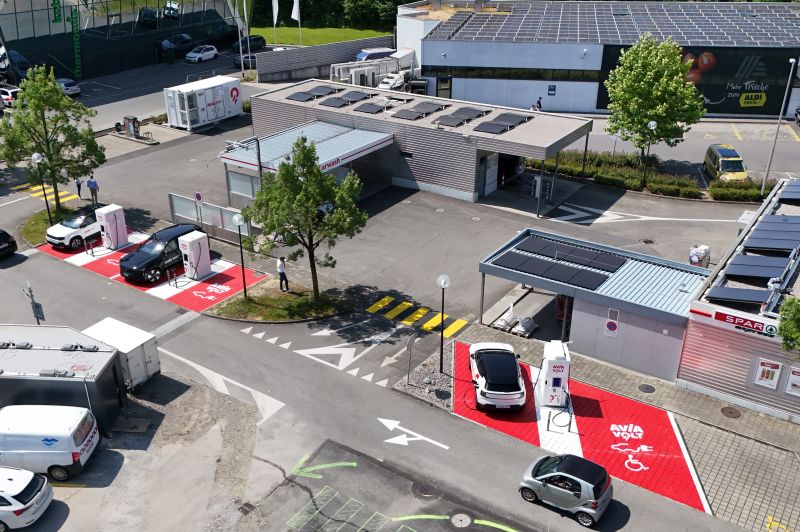
After more than 1.5 years of planning, it is now up and running: the new AVIA VOLT charging park in Dierikon (LU) – equipped with a 1 MWh/1 MW battery storage system, three fast charging stations, each with a charging capacity of 360 kW, and an intelligent energy management system from CLEMAP. A practical example that shows that with a well-thought-out system design, many electric vehicles – even those with high energy requirements – can be charged efficiently and without grid reinforcement.
At the start of the project, Schätzle AG, the operator of the AVIA gas station in Dierikon, faced a challenge: the decision had been made to expand the site with a charging park, the fast charging stations had been ordered—but the existing grid connection only offered 100 kW. A classic dilemma: electrification yes—but how, when the grid is limited?
AVIA VOLT Suisse, AVIA's center of excellence for electric mobility, develops practical charging infrastructure solutions for public charging and, in particular, for heavy-duty vehicles—with a focus on scalability, efficiency, and smart energy systems.
The key question for CLEMAP: How can multiple electric vehicles be charged simultaneously—with the support of photovoltaics and battery storage?
After a joint analysis phase, it was clear that a large battery energy storage system (BESS) combined with an intelligent load management system was a more economical, faster, and scalable solution. This is because:
This is how the project took shape—with an ambitious goal: ultra-fast charging without expanding the grid.
The project presented CLEMAP with a number of challenges: The battery storage system was manufactured in China, including assembly and initial testing in the winter of 2024/25. CLEMAP sent a load management device to China in advance to test communication with the storage system on site. That alone was exciting: Would the device actually arrive? Would everything work as planned?
The system was extensively tested at the Chinese production facility in collaboration with the battery manufacturer's engineering team, AVIA VOLT, and CLEMAP. The collaboration took place via WeChat, which was also a new experience for everyone involved. The shipment of the container in February/March 2025 was an important milestone: by then, all interfaces had to be functional and communication between the battery and CLEMAP load management had to be fully tested.
The project also broke new ground in Switzerland: for the first time, CLEMAP was able to use a solar inverter not only to measure, but also to actively control via Solar-Log when PV power flows into the battery or is fed back into the grid – a major step toward optimizing self-consumption. A solar inverter converts the direct current generated by the PV system into alternating current and enables the targeted control of self-consumption and grid feed-in. At the same time, it had to be ensured that the main connection box (HAK) was not overloaded when feeding back into the grid. The control system therefore had to be not only efficient but also safe – and it is.
We are proud of the fantastic collaboration within our CLEMAP Tech team: coordination between the individual departments was challenging and required a great deal of coordination—from load management and battery integration to PV connection. Thank you all!
Sandro was primarily responsible for the project and worked closely with the battery manufacturer in China.
Raffael took care of integrating the solar inverter—a first in CLEMAP projects, where it was possible to actively influence the feed-in for the first time.
Fabian was responsible for implementing and fine-tuning the load management system—from integration to practical configuration on site. A load management system intelligently distributes the available electrical power to multiple consumers—in this case, the charging points—and ensures that grid connections are not overloaded, charging processes are prioritized, and energy is used optimally.
Implementation at the Dierikon (LU) site began in spring 2025. From marking out the construction site to earthworks, cable routes, and foundations, right through to the final placement of the battery storage system—everything was done in close collaboration with local construction partners.
Images impressively document how a gas station area was transformed into a modern charging park with AVIA VOLT battery storage, red and white marked fast charging zones, and a clearly structured charging infrastructure.
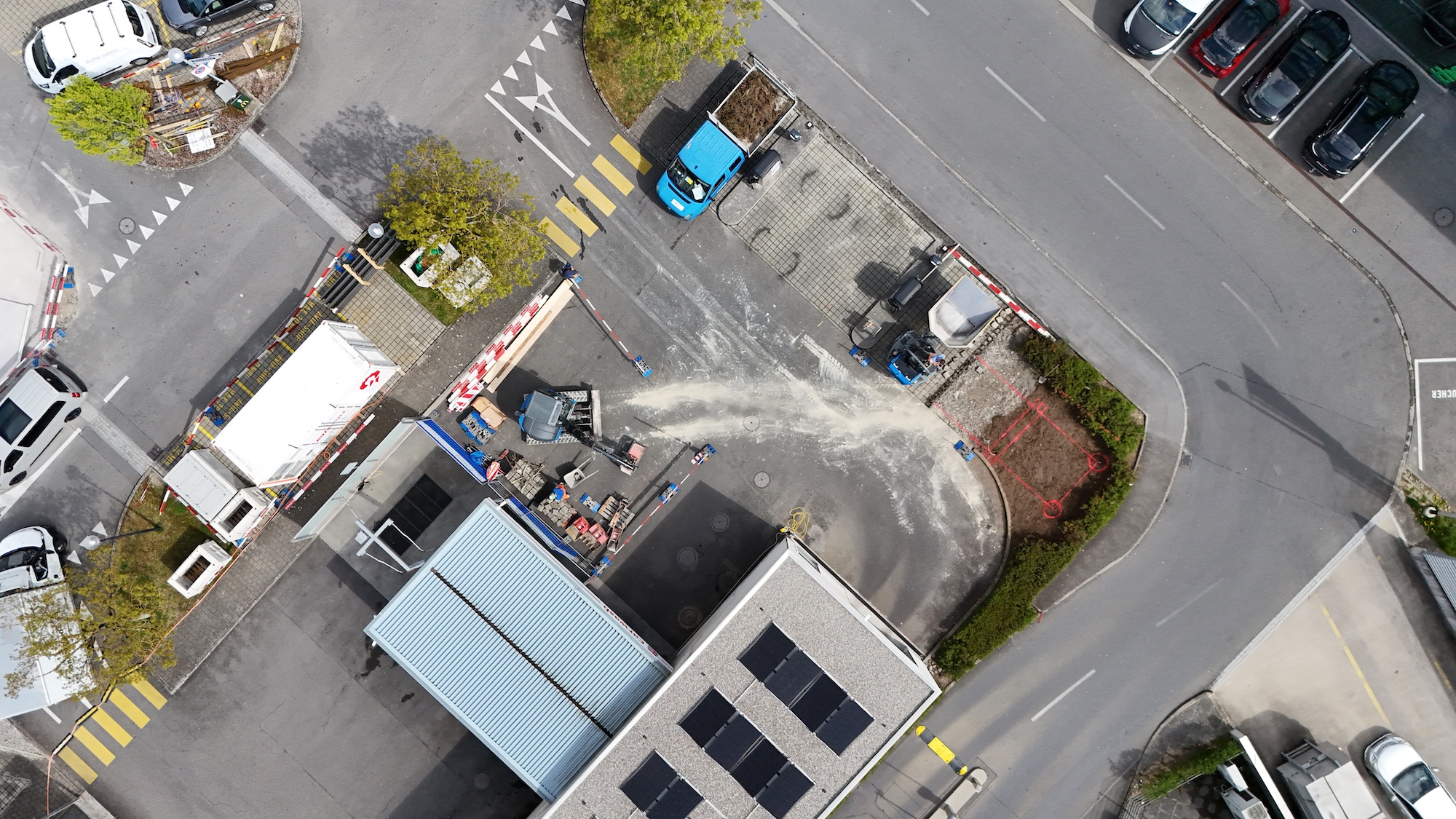
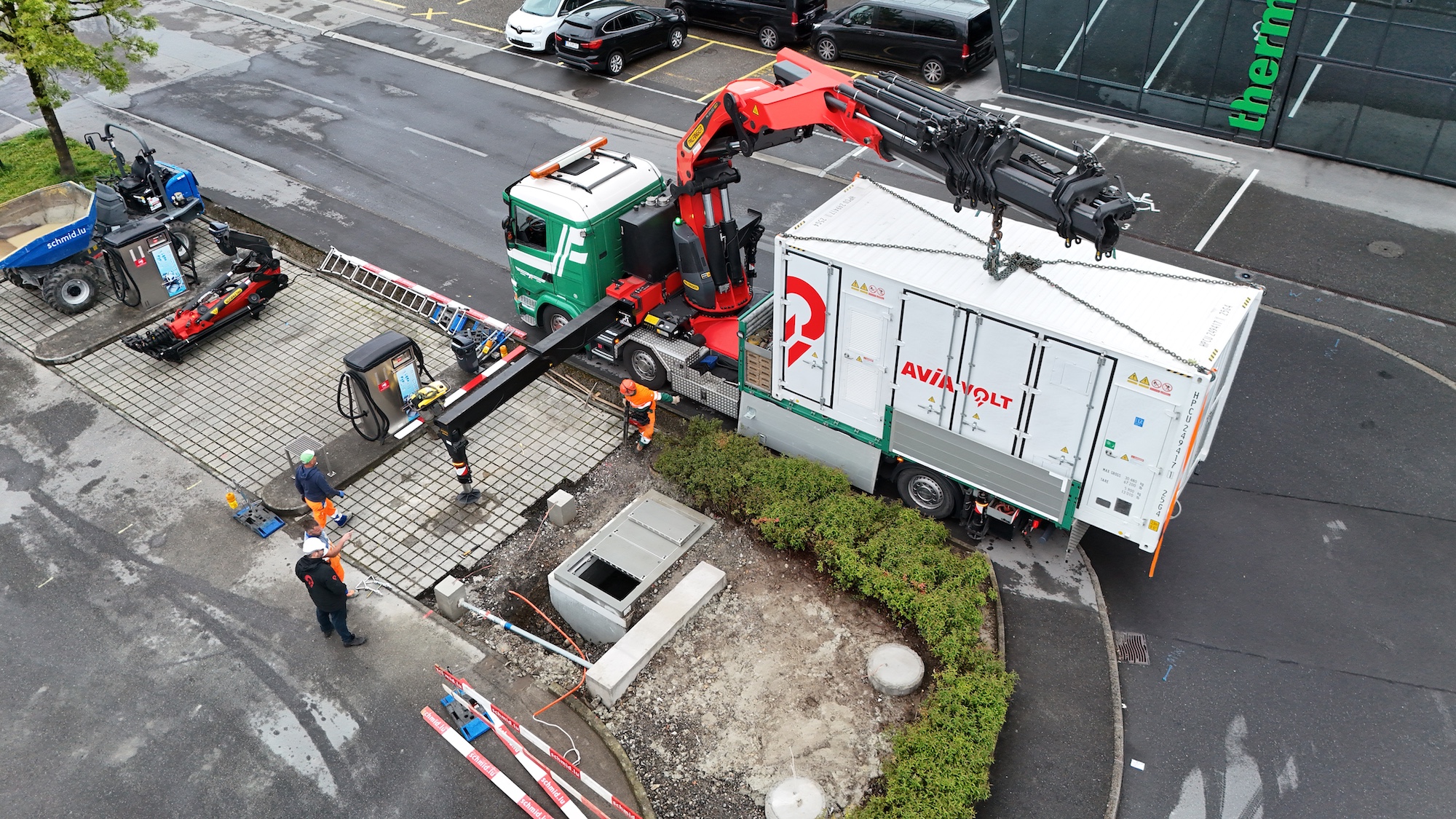
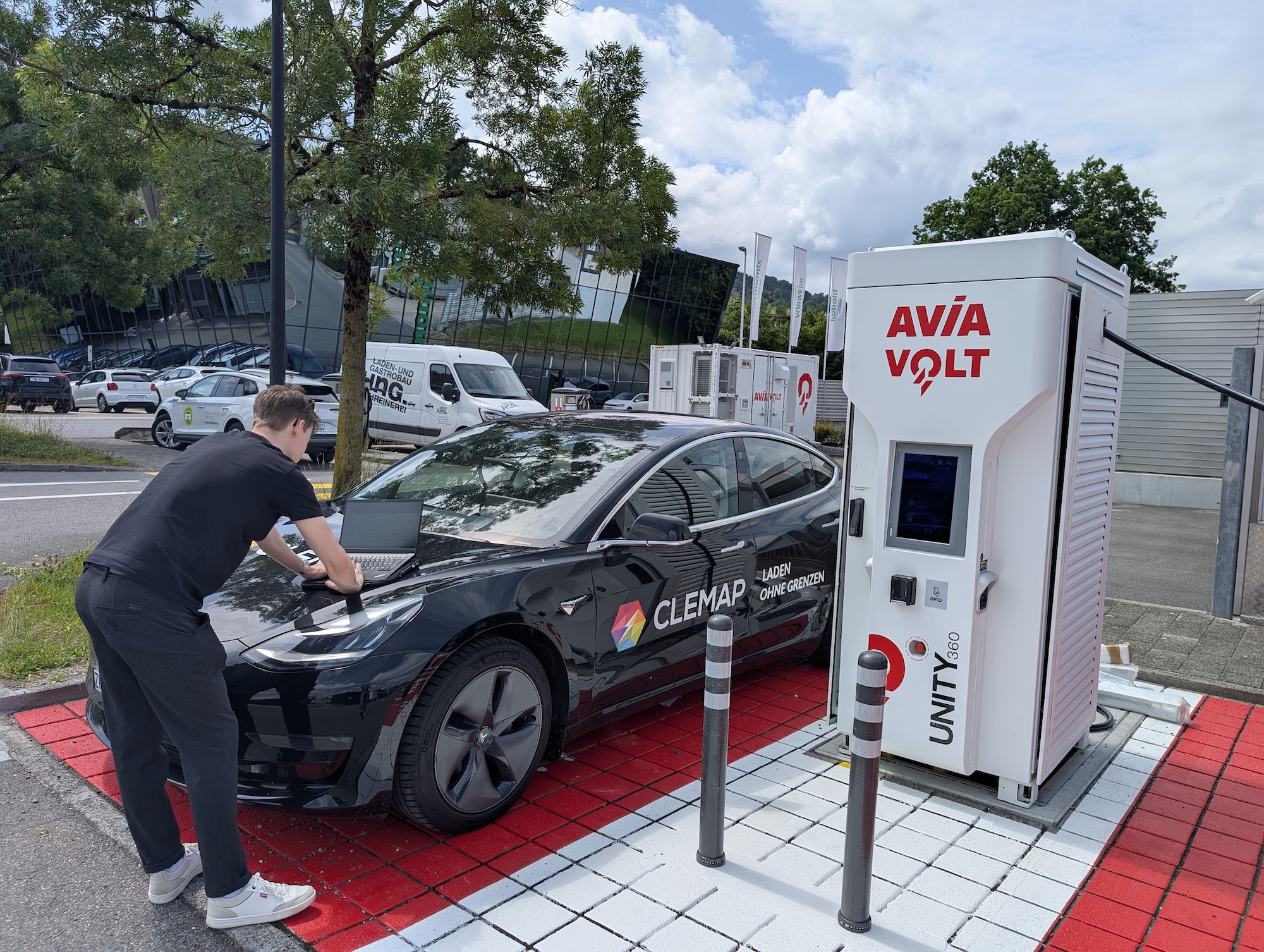
On June 16, 2025, the time had come: During the successful C-Booster test day on site, the entire system was put through its paces—under real-world conditions.
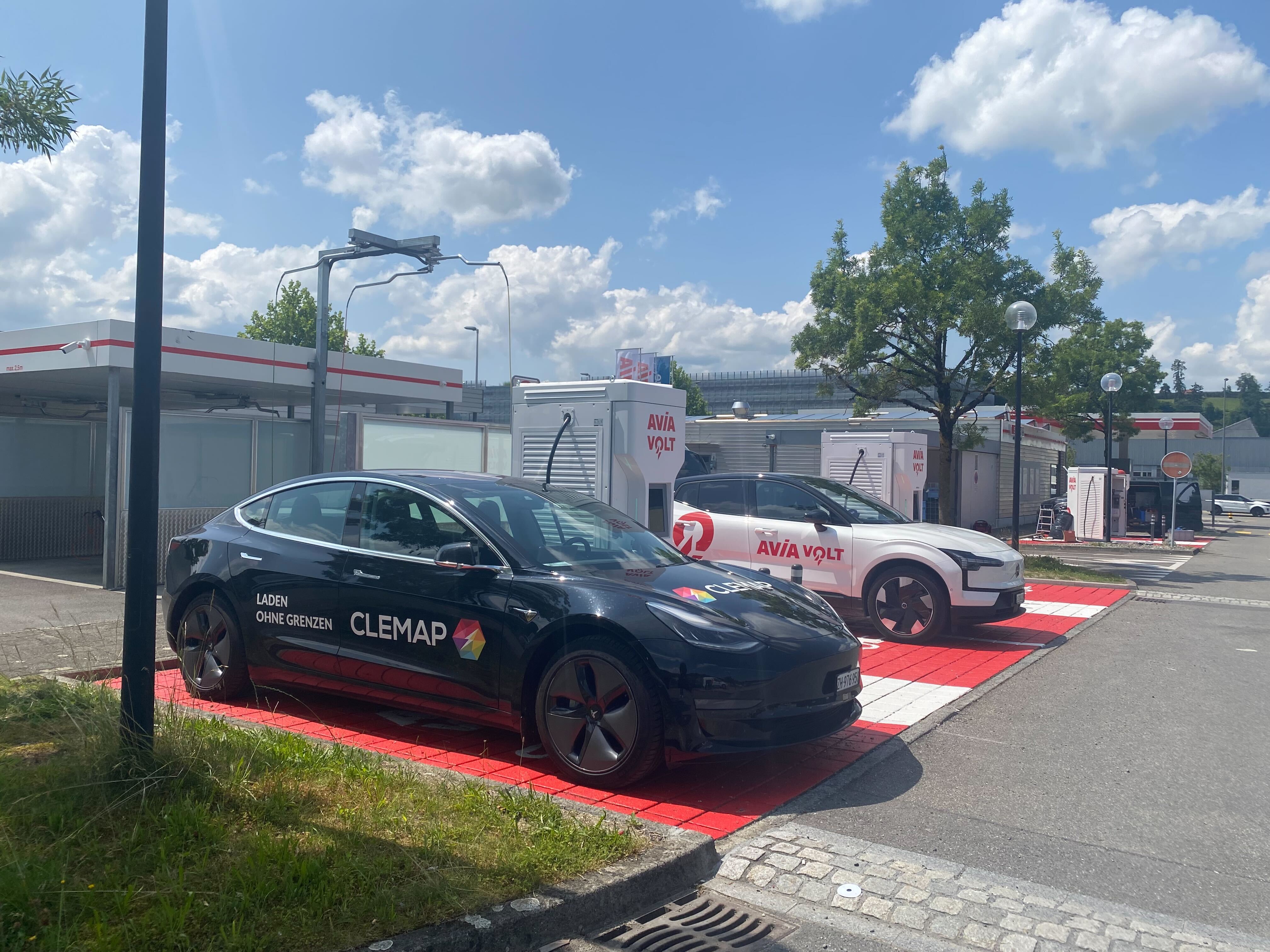
The charging park has been officially in operation since Monday, June 16, 2025—a moment we have all worked hard toward for a long time.
The inauguration with invited guests is planned for August. Until the end of September, customers can charge their vehicles at a special rate of 50Rp/kWh using their AVIA VOLT card or credit card.
The results in Dierikon speak for themselves: the combination of CLEMAP load management and battery storage enables fast and efficient charging—even with limited grid connection.
The result in operation:
The technical equipment at the charging park also demonstrates how scalable and practical the solution is:
The facility in Dierikon now comprises:
The battery storage system used is more than just a power buffer—it performs several functions simultaneously:
Control is automatic via the CLEMAP energy management system, which prioritizes AC and DC charging stations in real time and takes dynamic tariffs into account.
The example of Dierikon proves that the combination of CLEMAP load management and battery storage enables ultra-fast, grid-friendly charging for electric trucks—now and without waiting for grid expansion. Scalable, economical, future-proof.
Do you operate a charging park or are you electrifying your logistics fleet? Would you like to know how peak shaving works for you? Arrange a consultation with CLEMAP now and get your site ready for megawatt charging:
Festim Zeneli, festim.zeneli@clemap.com, +41 44 518 01 28